Causly Server: Give Your AI Agent an Environment to Actually Work
What if your AI agent had hands? Causly Server gives any MCP-compatible agent a place to actually work — from writing code and running commands to deploying, managing, and observing software.
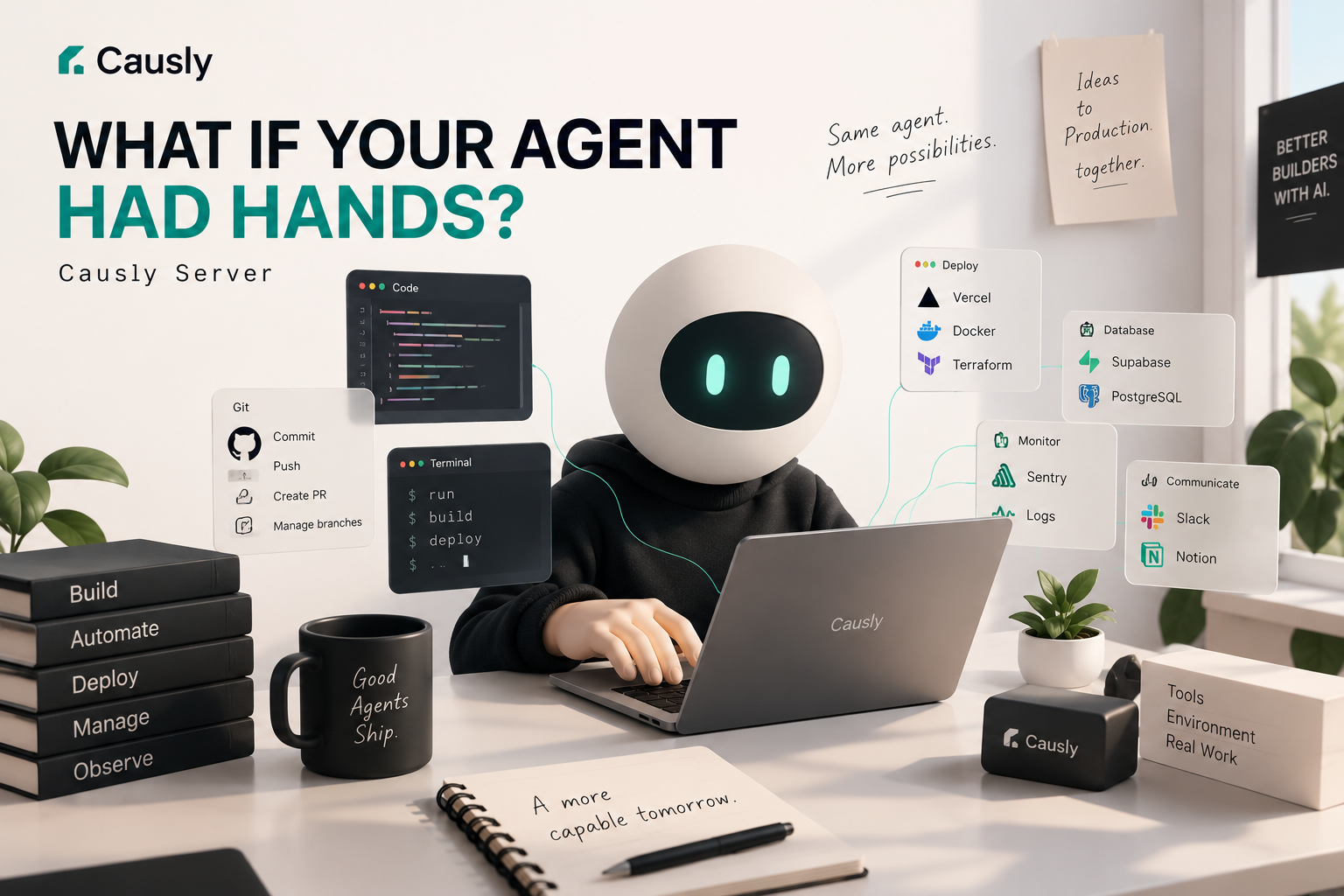
Causly Server: Give Your AI Agent an Environment to Actually Work
You can use Claude, Codex, Cursor, or build your own AI agent. The agent isn't the hard part anymore.
The harder part starts when you ask it to actually do something.
Build an application. Work with a repository. Run commands. Change infrastructure. Deploy something. Check logs. Fix an issue. Talk to the systems involved in the project.
Suddenly, the agent needs access to a lot more than a chat window.
That's where Causly Server comes in.
Causly Server is an open-source server for MCP-compatible AI agents. It brings together the tools an agent needs to work across the software development lifecycle, along with an isolated runtime environment where that work can actually happen.
The idea is simple:
Use whatever agent you like. Give it Causly.
Causly isn't another AI agent, IDE, or AI model. It sits underneath the agent and gives it a connected environment for doing real software work.
What is Causly Server?
At its core, Causly Server combines two things: MCP capabilities and an isolated runtime environment.
MCP gives an AI agent a standard way to interact with external tools and systems.
Causly goes a step further.
Instead of treating every capability as an isolated tool, Causly brings the tools and the environment together inside a server designed around software development work.
An agent can connect to Causly and work with things like:
- Git and GitHub
- Shell
- Docker
- Terraform
- SQL
- Supabase
- Vercel
- Sentry
- Slack
- Notion
- Gmail
- CI/CD workflows
- Security tooling
- Project intelligence
- File operations
These aren't meant to be a random collection of integrations.
They're pieces of the environment an agent needs when it's actually working on a software project.
The server becomes the layer between the agent and the systems it needs to interact with.
AI Agent
   │
   │ MCP
   ▼
Causly Server
   │
   ├── Runtime Environment
   ├── Development Tools
   ├── Infrastructure Tools
   ├── Project Tools
   └── External Services
The agent remains the agent.
Causly provides the place where it can work.
Why call it a Server?
Because Causly is more than an MCP endpoint.
An MCP server can expose tools to an agent. That's useful, but Causly is designed around a broader problem.
The agent needs somewhere to execute work. It needs access to files, commands, repositories, infrastructure, databases, deployments, monitoring systems, and other parts of the development lifecycle.
Causly brings these capabilities together in a server that can be connected to by an MCP-compatible agent.
The connection can be authenticated with an API key, allowing the agent to access the Causly environment without being tightly coupled to a particular AI product.
That's an important part of the design.
Causly doesn't choose your agent for you.
Use the Agent You Already Like
Causly isn't trying to replace Claude. It isn't trying to replace Codex. It isn't trying to replace Cursor. And it doesn't require you to use a Causly-specific agent.
If the agent supports MCP, it can connect to Causly.
That means the same Causly Server can sit behind different agents and workflows.
You might use one agent for coding, another for reasoning, and another for a custom internal workflow. The environment doesn't have to change every time the agent changes.
That's the point. Your agent is the interface you work with.
Causly is the environment behind it.
What Can an Agent Actually Do With Causly?
This is where Causly becomes more interesting than a list of integrations.
The goal isn't simply to let an agent call APIs.
The goal is to let it move through the actual work involved in building and operating software.
Build
An agent can work with repositories, files, shell commands, SQL, and development tooling.
It can inspect a project, modify files, create changes, work with Git, and perform development tasks from within the environment.
Automate
Once an agent can interact with the systems around a project, workflows can span multiple tools.
A task doesn't necessarily stop at:
“Write this code.”
It can continue into:
“Change the code, run the relevant commands, commit the changes, and move the project through the next step.”
Deploy
Development doesn't end when code is written.
Causly includes infrastructure and deployment capabilities such as Terraform, Docker, and Vercel.
That allows an agent to interact with the infrastructure involved in getting software running.
Manage
Software projects contain more than code.
There are tasks, documentation, communication, databases, project information, and operational systems.
Causly connects agents with tools such as Notion and Slack alongside the technical systems they already use.
Observe
After deployment, something can break.
Causly includes operational tooling such as Sentry so agents can work with information coming from running systems.
This creates a much more complete loop:
build → automate → deploy → manage → observe
That's the environment Causly is designed to provide.
Causly Is Built Around the Software Development Lifecycle
Causly isn't trying to become a universal tool hub for every possible AI use case.
Its focus is narrower. Software development and the work surrounding it.
That's why the tools inside Causly are connected to different parts of the lifecycle.
- A project might start with a repository.
- Then code needs to be written and tested.
- Infrastructure needs to be configured.
- Services need to be deployed.
- Databases need to be accessed.
- Teams need to communicate.
- Documentation needs to stay updated.
- Production systems need to be observed.
These are different systems, but they're part of the same work.
Causly brings them into one environment that an AI agent can interact with.
The Causly Server Architecture
The architecture is intentionally straightforward.
An MCP-compatible agent connects to the Causly Server.
Causly handles the connection to its available tools and runtime environment.
Those capabilities then connect the agent to the systems involved in the project.
Conceptually:
                    MCP-Compatible Agent
               ┌──────────────────────────┐
               │ Claude / Codex / Cursor  │
               │ Custom Agent / Other     │
               └────────────┬─────────────┘
                            │
                         MCP/API
                            │
                            ▼
                  ┌──────────────────────┐
                  │    Causly Server     │
                  │                      │
                  │  MCP Interface       │
                  │  Runtime Environment │
                  │  Tooling             │
                  │  Workflows           │
                  └──────────┬───────────┘
                             │
          ┌──────────────────┼──────────────────┐
          │                  │                  │
          ▼                  ▼                  ▼
       Git/GitHub         Docker/Terraform    Vercel
       Supabase           SQL                 Sentry
       Slack              Notion              Gmail
       Shell              FileOps             CI/CD
The important part isn't the diagram itself.
It's the separation of responsibilities.
The agent provides intelligence.
Causly provides the working environment.
Causly Server OSS
The first version of Causly Server is open source.
The OSS server is released under the MIT License and can be self-hosted.
It contains the core Causly environment and its available tooling, so developers can run Causly themselves rather than depending on a hosted service.
That matters because Causly is meant to be infrastructure.
You should be able to understand what you're running, control it, modify it, and build on top of it.
The OSS version is also where Causly is being built in the open.
You can explore the server, use it with your own MCP-compatible agent, and contribute to the project.
Causly Hosted
There is also a hosted version of Causly.
The idea is simple: not everyone wants to operate the server themselves.
With the hosted version, Causly takes care of the server-side environment so teams can connect their agents without having to manage the underlying infrastructure themselves.
The underlying idea remains the same.
OSS gives you the server.
Hosted gives you the managed version of that server.
The hosted product is still being developed, while the OSS version is already usable.
What Causly Is Not
It helps to be clear about what Causly isn't.
Causly isn't an AI model
Causly doesn't provide the intelligence.
You bring the model and agent you want to use.
Causly isn't an AI agent
Causly doesn't make decisions on your behalf or pretend to be another autonomous agent.
It provides the environment an agent can work through.
Causly isn't an IDE
You don't need to replace your existing development environment with Causly.
Use the tools and agents you already prefer.
Causly isn't an MCP collection hub
The tools inside Causly aren't there simply to create a long list of integrations.
They're organized around a specific purpose: giving AI agents access to the systems and environment involved in software development.
Causly isn't fully autonomous
Causly provides capabilities that agents can use.
How much autonomy an agent has depends on the agent, the workflow, permissions, and how you configure the environment.
Causly doesn't need to make the promise that everything happens without humans.
The infrastructure comes first.
Why the Agent Shouldn't Matter
One of the things we care about most with Causly is avoiding unnecessary lock-in.
AI agents are changing quickly. The agent you prefer today might not be the agent you use next year.
Your infrastructure shouldn't have to be rebuilt every time.
That's why Causly is built around MCP.
The goal is simple:
Bring your agent. Connect it to Causly. Keep working.
Claude, Codex, Cursor, or a custom MCP-compatible agent — the choice stays with you.
Causly is the layer that remains useful underneath.
Where Causly Is Going
Causly Server is being built around one simple direction: Make AI agents capable of doing more real work.
- Not by creating another agent.
- Not by building another coding interface.
- And not by forcing everyone into the same model.
Instead, Causly focuses on the environment around the agent.
- The repositories.
- The infrastructure.
- The databases.
- The deployments.
- The monitoring.
- The project systems.
- The commands.
- The workflows.
The things an agent needs after it stops simply generating an answer and starts actually doing the work.
The open-source server is the foundation.
The hosted version is the managed path.
And the long-term goal is to make that environment increasingly useful without taking control away from the people using it.
Start With Causly Server
If you're already using an MCP-compatible AI agent and want it to interact with the systems around your software projects, Causly Server is built for exactly that.
You don't need to change your agent.
You don't need to adopt another AI model.
You don't need to replace your IDE.
You can start with the open-source server, connect the tools you need, and give your existing agent a place to actually work.
Use whatever agent you like. Give it Causly.
And let the agent do more than just talk about the work.