What If CRM, CLM, and Business Operations Worked as One?
CRM manages the deal. CLM manages the contract. Other tools manage payments, delivery, and follow-ups. But what if they were all connected around the agreement instead of operating as separate systems?
- 1.Your IT Service Company Has Agreements. But Who Actually Operates Them?
- 2.Why CRM and CLM Shouldn't Be Separate Worlds
- 3.Deal to Agreement: Where the Operational Gap Actually Begins
- 4.Why Agreements Become a Second System After the Deal Closes
- 5.What If CRM, CLM, and Business Operations Worked as One?
- 6.I Built AgreeOps to Connect Deal to Done
What If CRM, CLM, and Business Operations Worked as One?
A customer relationship rarely lives in one system.
- The CRM knows the customer and the deal.
- The CLM (Contract Lifecycle Management) system knows the contract.
- Finance knows the payments.
- Project management tools know the delivery.
- Email and Slack know the conversations.
Each tool has a job.
The problem is that the customer relationship has to move between all of them.
What if it didn't?
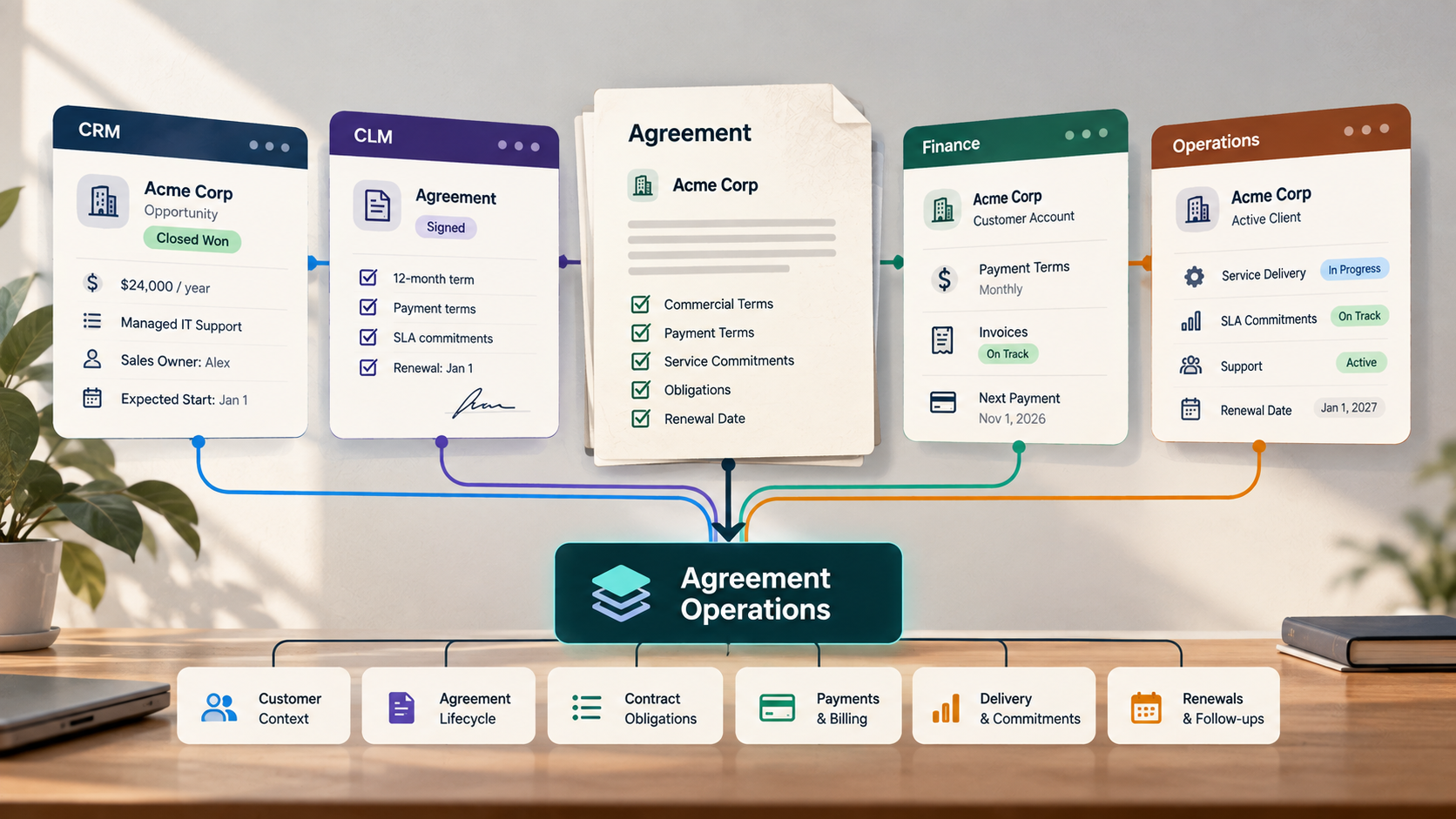
The same customer, five different systems
Imagine an IT services company signs a new client.
The deal is managed in Salesforce. The contract is created and signed through a CLM platform. The invoice is handled somewhere else. The delivery team manages the project in another tool. And the renewal date ends up in a calendar.
Nothing is necessarily wrong with any of these tools.
But the company now has several different versions of the same relationship.
The CRM knows what was sold. The contract knows what was agreed. Finance knows what was paid. Operations knows what needs to be delivered.
But who knows everything?
CRM and CLM solve different problems
CRM software is built around customer relationship management.
It helps teams manage leads, opportunities, accounts, sales activity, and customer relationships.
CLM software is built around contract lifecycle management.
It helps teams create, review, approve, sign, store, and manage contracts.
Both are useful. But there is a gap between them.
A deal doesn't stop being important when it becomes a contract. And a contract doesn't stop being important when it gets signed.
The information inside that agreement can affect the business for months or years.
What if the agreement became the connection?
Instead of treating CRM, CLM, finance, and operations as completely separate systems, imagine them working around the same business relationship.
A customer enters the CRM. The deal is negotiated. The commercial terms move into the agreement. The agreement gets approved and signed. Then the agreement becomes the source of operational context. Payment terms connect to finance. Deliverables connect to delivery. Contract obligations become trackable. Renewal dates become actionable. Changes to the agreement remain connected to the customer relationship.
The systems can still exist. But the context doesn't have to break apart.
From contract management to agreement operations
This changes what agreement management could look like.
Instead of asking:
"Where is the contract?"
you could ask:
"What's happening with this agreement?"
- Is it active?
- What did we agree to?
- What obligations are still open?
- When does it renew?
- What payments are due?
- Who owns the next action?
- What changed since the agreement was signed?
Those are operational questions.
And answering them shouldn't require opening a PDF, searching an email thread, checking a CRM record, and asking someone in Slack.
One relationship. One operational context.
The goal isn't necessarily to replace every tool a company already uses.
CRM still has a job. CLM still has a job. Finance still has a job. Project management still has a job.
But the business needs a way to connect these pieces around the agreement and the relationship it represents.
That could make the journey much simpler:
Customer → Deal → Agreement → Obligations → Delivery → Renewal
Instead of:
CRM → CLM → PDF → Email → Spreadsheet → Finance → Project Tool → Calendar
The difference looks small on paper. In day-to-day operations, it isn't.
Maybe the problem isn't another tool
We've spent years building specialized software for every part of the business.
CRM for sales. CLM for contracts. ERP for finance. Project management for delivery. Communication tools for everything in between. Specialization makes sense.
But eventually, someone has to connect the dots.
For businesses that run on client agreements, the agreement is one of the few things that touches almost every stage of the relationship.
Maybe that's the better place to build from.
Not another system that replaces everything.
But an agreement operations platform that brings the important parts of the relationship together and turns the agreement into something the business can actually operate.
That's the idea behind AgreeOps.