Why CRM and CLM Shouldn't Be Separate Worlds
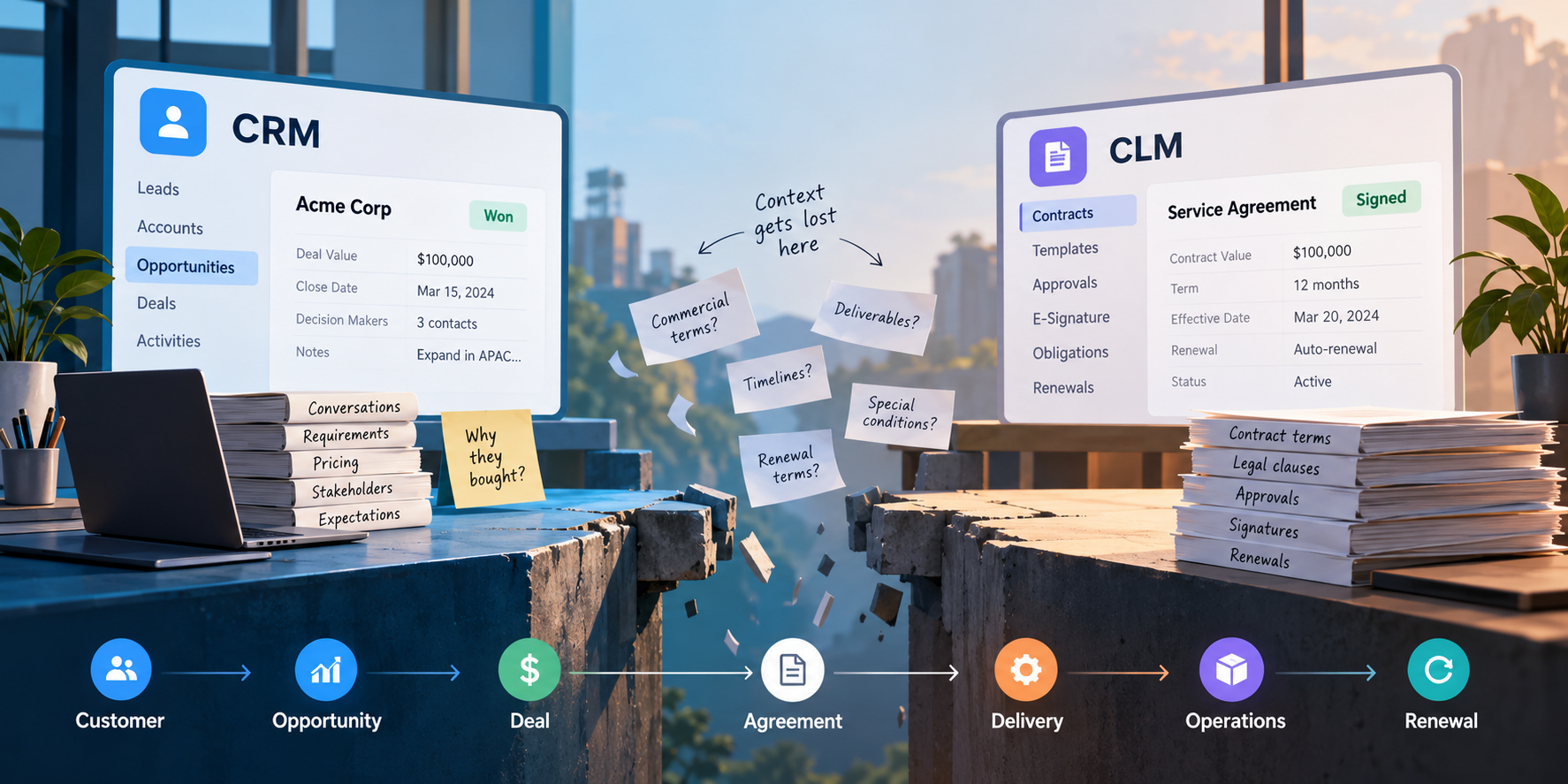
CRM knows how the deal was won. CLM knows what was signed. But neither is really designed to manage what happens between the two — leaving a structural gap where critical context gets lost.
- 1.Your IT Service Company Has Agreements. But Who Actually Operates Them?
- 2.Why CRM and CLM Shouldn't Be Separate Worlds
- 3.Deal to Agreement: Where the Operational Gap Actually Begins
- 4.Why Agreements Become a Second System After the Deal Closes
- 5.What If CRM, CLM, and Business Operations Worked as One?
- 6.I Built AgreeOps to Connect Deal to Done
Why CRM and CLM Shouldn't Be Separate Worlds
A company wins a deal in its CRM.
Then, somewhere else, someone creates a contract.
The contract gets negotiated in another workflow, sent for signature, stored in a document system, and eventually handed over to the team responsible for delivering what was promised.
Somewhere in between, the original deal context starts disappearing.
That is the structural problem with treating CRM and CLM (Contract Lifecycle Management) as completely separate worlds.
The problem isn't that CRM and CLM are bad tools.
The problem is that the agreement sits directly between sales and operations — yet the systems around it often treat it as a separate object.
The deal doesn't end when the contract is created
A CRM is built around the customer relationship and sales process.
It knows things like:
- Who the customer is
- What they are buying
- Deal value
- Sales stage
- Decision makers
- Expected close date
- Commercial discussions
- Account history
A CLM system, meanwhile, is designed around the contract lifecycle:
- Creating agreements
- Reviewing clauses
- Managing versions
- Approvals
- Negotiation
- E-signature
- Contract storage
- Renewals and obligations
Both systems make sense on their own.
But look at the actual business workflow:
Customer → Opportunity → Deal → Agreement → Signature → Delivery → Renewal
The agreement isn't a separate event.
It is the bridge between the deal and the work the company eventually has to perform.
And that's where the structural gap appears.
Look at how Salesforce itself describes the workflow
Salesforce's own documentation separates the sales process from its contract and order processes.
A sales opportunity can eventually lead to an order, while Salesforce CPQ and contract functionality handle the commercial and contractual steps around that transaction.
That makes sense from a software architecture perspective.
But from the company's perspective, something much simpler is happening:
"We sold something to this customer. Now we have to deliver what we agreed to sell."
The customer doesn't think in terms of CRM, CPQ, CLM, ERP, and project-management boundaries.
They think:
"This is what I bought. This is what you promised. Now deliver it."
That's the continuity modern businesses actually need.
CRM knows the deal. CLM knows the agreement.
Imagine a sales team closes a $100,000 annual services agreement.
The CRM may contain the original opportunity, account history, stakeholders, deal value, and sales notes.
The CLM system may contain the final agreement, negotiated clauses, approval history, signatures, and contractual dates.
But now the delivery team needs to answer different questions:
What exactly did we promise?
Which services are included?
What are the deadlines?
Who is responsible for each obligation?
When does the agreement renew?
Were there special commercial terms negotiated during the sale?
Those answers are often scattered across the CRM, contract, emails, documents, and conversations.
The contract contains the legal commitment.
The CRM contains the commercial context.
Operations needs both.
The handoff is the real problem
This is why simply saying "CRM and CLM should integrate" doesn't completely solve the problem.
An integration can move data from one system to another.
It doesn't automatically preserve the meaning and context of the deal.
Consider the difference.
A CRM might pass:
Customer: Acme
Deal value: $100,000
Product: Enterprise Services
That's useful.
But the actual agreement might say:
- 12-month term
- Monthly service obligations
- Specific response-time commitments
- Payment milestones
- Renewal conditions
- Customer-specific requirements
- Exceptions negotiated during the deal
Now operations has two pieces of information:
What was sold.
and
What was legally agreed.
The real operational requirement is:
What do we now need to do because we sold and agreed to this?
That third layer is where traditional CRM + CLM structures become weaker.
The agreement is the missing bridge
This is why the agreement shouldn't be treated as the endpoint of sales.
It should be treated as a transition point into operations.
The flow should look more like:
CRM
Customer
↓
Opportunity
↓
Deal
↓
Commercial Terms
Agreement
Terms
↓
Review
↓
Negotiation
↓
Approval
↓
Signature
Operations
Obligations
↓
Payments
↓
Deliverables
↓
Renewals
↓
Customer Relationship
The important thing isn't necessarily putting every feature into one giant application.
It's maintaining one continuous business context across the entire lifecycle.
The customer shouldn't become a new record just because the deal became a contract.
The contract shouldn't become a dead PDF just because it was signed.
And the sales context shouldn't disappear once the opportunity becomes an agreement.
Why this matters for almost every B2B company
This isn't limited to large enterprises.
Any company that sells recurring services, projects, subscriptions, retainers, implementations, or other contractual work eventually faces the same transition.
An agency closes a client.
An IT services company signs a managed-services agreement.
A consulting firm agrees to a six-month engagement.
A construction company signs a project contract.
A SaaS company signs an enterprise customer.
Different industries.
Same underlying problem:
The thing sold to the customer becomes a set of commitments the company has to operate.
That's why the gap between CRM and CLM matters.
The more complicated the agreement, the more expensive that gap becomes.
A missed renewal date, forgotten obligation, incorrect commercial assumption, or lost commitment isn't just a documentation problem.
It can become an operations problem, revenue problem, or customer relationship problem.
Integration isn't the final answer
The obvious answer is:
"Just integrate the CRM and CLM."
And yes, integrations are useful.
But connecting two systems isn't the same as connecting the workflow.
The deeper question is:
What happens to the deal after it becomes an agreement?
If the answer requires people to manually copy information between systems, search through contracts, read old emails, and reconstruct what was promised, the business still has a broken workflow.
The goal shouldn't simply be CRM + CLM integration.
The goal should be continuity:
Deal → Agreement → Operations
with the context preserved throughout.
From Agreements to Operations
This is the larger idea behind Agreement Operations.
An agreement shouldn't be the final document produced by the sales process.
It should become the operational source of truth for what the company now needs to execute.
CRM answers:
"What are we selling?"
CLM answers:
"What are we agreeing to?"
Operations needs to answer:
"What do we now have to do?"
Those aren't three unrelated questions.
They're three stages of the same customer lifecycle.
And that's why CRM and CLM shouldn't be separate worlds.
They don't necessarily need to become one giant system.
But the deal, agreement, and operational work that follows should behave like one continuous workflow.
That's the gap Agreement Operations is designed to close.